Wednesday, September 22, 2010

Say Hello to the New Guys


The Year of Ceratopsians continues with two new additions to the Chasmosaurinae: Utahceratops gettyi and Kosmoceratops richardsoni. I will give you two guesses as to where the former was discovered. Here's one hint: It's in the name. There was absolutely nothing about this animal that warranted a better, more imaginative moniker. Meanwhile, Kosmoceratops is heavily airbrushed, full of fashion advice, and knows the top ten ways to make your bull go wild in the bedroom. Another surprise is that Chasmosaurus irvinensis is renamed Vagaceratops irvinensis, as it turns out to be closer to Kosmoceratops than Chasmosaurus.

But seriously, this is fantastically exciting. The paper was published in PLoS One and is thus freely available for all. Check out the paper by clicking this lengthy link, but don't be surprised if you can't see the pictures or download the paper as a PDF. It would seem that PLoS One went on hiatus the second this paper was announced, thus going from "awesome free-access journal" to "cocktease."

But don't cry about it--go to The Internets, where people have been blogging about these new dinosaurs all morning. Do you want to know more? Click these links to do just that!

Archosaur Musings
The Open Source Paleontologist
Dinosaur Tracking
Dinochick Blogs

Don't get too excited: they're probably all just ontogenetic stages of each other.

Thursday, September 16, 2010

Gaming Update

Nobody asked for this, but I’m writing it anyway because (1) I enjoy writing, and (2) My post about Concavenator is taking longer than expected. So here’s one of those long, rambling gaming updates where I talk about what I’ve been playin’ and you all get to sit here and listen.


The Conduit (Wii)
I’m about two years too late, but hey, Fred Meyer was virtually giving this game away, quietly pleading for its customers to take heed this Great Deal and free up shelf space for better software like Daisy Fuentes Teaches Pilates. You might think I made that game up, but I did not. It’s sitting there for you to buy. I do not object to the inclusion of Daisy Fuentes, but the very fact that a Pilates game exists makes me shudder with fear. This is an activity best served on Microsoft’s upcoming failure, Kinect, rather than the Wii Balance Board.

Anyway, back to The Conduit. Despite early hype back when it was released in 2009, The Conduit is very much a paint-by-numbers corridor shooter. It’s certainly not bad, but it’s not great either, and whenever the game escapes the confines of endless hallways and monster closets, bursting into larger outdoor vistas, it promptly falls flat. Eager to “push” the hardware, the developers revel in their ability to throw multiple high-powered enemies at you from all directions. Strategy has no meaning here—your only recourse is to “brute force it,” as they say, running amok, guns a-blazing, hoping you survive long enough to reach the next checkpoint. I have not partaken in The Conduit’s supposedly robust online multiplayer offerings, which includes Wii Speak support. My misgivings do not result from the game itself, but my own failures as an online shooter gamer. Previous attempts, which have been valiant, were given to Call of Duty 4, Halo 2, Halo 3, and Modern Warfare 2. All ended in tragedy. To be fair, I did somehow enjoy myself in all efforts, but it was clearly not where my skills existed. If forced to play a multiplayer shooter, I will choose something sufficiently old-school, like Turok 2 or Goldeneye 007, in which modern frills had not been invented, and my limited skillset leads to as many victories as losses, though that number, on average, is often skewed toward the latter.

Dragon Quest IX (DS)
In the same way that the core Pokemon games dig their Razor Claws into my soft hide, Dragon Quest IX has proven to be an unwavering master. Though I recently completed the main story, my tasks are far from complete, as there are Quests to pursue, Alchemy to perform, and Grottos to explore and conquer. I have also been experimenting with the game’s many Vocations (jobs), taking my Lv. 45 Minstrel back down to a Lv. 1 Thief and leveling her up from there, to happy results—although I wish she could carry a shield. My goal now is fuzzy and undefined: leveling up and bettering my equipment occupies the majority of my time, and traveling to Grottos to find ever-rarer alchemical ingredients is a rare, but welcome affair.

I have been wholly unable to make use of the game’s “Tag” mode, in which players can passively download maps where their DS systems sense each-other’s presence. Additionally, Dragon Quest IX features a unique local multiplayer system whereby two players can travel to each-other’s worlds, gathering alchemy recipes and finding items unique to that particular world. Alas, none of my DS-owning friends have any interesting in a traditional Japanese RPG, so I’ll have to wait until one of my NWR colleagues takes my offer of pizza and beer at the Mooses’ Tooth to get my multiplayer on. I’m taking a short break from the eternal grinding of the post-game material to experience the joy of Chrono Trigger (see below).


Bioshock 2: Minvera’s Den (PS3)
My adoration for 2K’s dystopian Bioshock brand is well-established. I’ve played the original brilliant game like three times. I’ve played its sequel through once, and tried on the multiplayer but felt it unrefined and, frankly, unnecessary. The developers have released two or three expansions and tweaks to the multiplayer game, but I was pleasantly Electro-Bolted last week to discover that they recently released a big beautiful single-player expansion called Minerva’s Den. For all intents and purposes, this is an original entry in the series, with little to no immediate connection to the events of Bioshock or its sequel. Taking place after the death of Andrew Ryan and possibly parallel to Sophie Lamb’s final, desperate attempts at control, Minerva’s Den tells the story of the two programmers who built Rapture’s central computer. Your journey takes you into entirely new locales. While still a Big Daddy, your protagonist becomes far more defined by game’s end and the story of Minerva’s Den is one of haunting tragedy and redemption.

The game offers up a new Plasmid, a very effective new weapon, a few new Tonics, and Trophies. There’s also a fun subquest and quicker “defend the Little Sister” segments. While this expansion lasts roughly eight hours (more if you’re trying to complete the subquest), it feels very complete, and in no way overstays its welcome. Minerva’s Den brings to mind the magic of the original Bioshock, and offers a more satisfying ending than Bioshock 2 did. Now we have to wait almost two years for the next iteration of the franchise, but I assure you that Bioshock Infinite looks incredible even at this early stage.
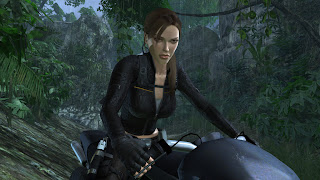

Tomb Raider: Underworld (PS3)
I’m actually replaying this game, but I have a good reason. When I first bought the game, I played through very quickly. I loved it. It was a graphical leap above Tomb Raider: Legend and Tomb Raider: Anniversary while retaining the excellent gameplay of those titles. Underworld, however, suffers from some bugs and performance issues. It’s very easy for Lara to get stuck on geometry or misjudge jump distance or direction during a jump. You have to babysit the camera every step of the way, although this does lead to unexpectedly, but pleasant, looks right down Lara’s shirt. During gunfights and certain platforming sequences, however, the camera is a real burden. The game looks absolutely drop-dead gorgeous—one of the best-looking games on the system as far as I’m concerned—but that graphical fidelity comes with a steep price: framerate issues, especially when bloom lighting is a part of the scenery. I really do like games of this ilk, however. That is, games that feature a bunch of environmental puzzles and platforming.

I’m replaying the game because it updated a year or so ago to include Trophies. Sadly, they are not retroactively applied. So despite completing the game—including finding 100% of the pickups and unlocking Lara’s terrible “bonus” costume (it's a palatte swap)—I didn’t get any Trophies for my efforts once the patch was downloaded. So over the past year, I’ve been slowly replaying the game, only recently getting back into it. Thankfully, I remember where all the really hard-to-find pickups are, but I imagine some backtracking will be required to find the more common treasures. There are only two levels left, and the last one is incredibly short (basically a lead-up to a boss sequence), so I should have this in the bucket before too long. I’m excited to try Lara’s new game, Lara Croft: Guardian of Light, which is already out on the 360 but launches toward the end of this month on the PSN. It’s been getting amazingly good reviews.

Quick Hits
Here’s a list of games I play from time to time—basically, when I get around to them.

Bayonetta (PS3)
I can say with unwavering honesty that I have never played a video game that’s as self-aware and over-the-top as Bayonetta. I enjoy it immensely, but it exists well within the realm of a genre I’m not usually a fan of. At its core, it’s a 3D brawler, but more akin to Devil May Cry and Viewtiful Joe than God of War. It is fast-paced, requires some modicum of precision, and is mission-based. None of this is surprising given the fact that the developers worked on…Devil May Cry and Viewtiful Joe before this. It is an overtly sexual game, though not in the way you’d think: there are no bikini-clad Dead or Alive goddesses here. Bayonetta herself is fully clothed, but adopts a handful of moderate-to-heavily suggestive poses and positions while destroying her angelic enemies. At the same time, the whole game is ridiculously campy. It’s an interesting dichotomy that works for me. Plus, the game was half off. I’m early in the goings, and I imagine things will become steadily more complex the farther I go down this particular rabbit hole.

Chrono Trigger (DS)
My motivation for buying this old-school, genre-defining RPG was twofold. First, it is at the top of my “Secret Shame,” list. These are games I have always meant to experience but never got around to. When Chrono Trigger first came out on the DS several years ago, I almost picked it up, but grimaced at the patented Square Tax that jacked the price up beyond normal DS standards. I was reasonably certain the price would fall in the coming months. This did not occur. My copy was recently procured secondhand, using the remaining store credit I had at the cursed Play ‘n’ Trade, thus breaking my ties to that merchant and revealing my second motive for purchasing the game. It’s a great game so far, although the combat system has demanded some adjustment. If you’ve played the Penny Arcade Adventures games, you’ll have a better understanding of it, though it’s faster-paced in Chrono Trigger. I still don’t like Akira Toriyama’s art, though.


A Boy & His Blob (Wii)
It’s taking me an ungodly amount of time to finish this game, as I’ve had it since November. It’s not terribly challenging; it’s just slow-moving, and I’m a rampant completionist, so I’m compelled to find all of the treasures in each level. I’m halfway through the third world and I genuinely feel like I’ve seen it all, and that everything from here on in is just going to be repetitious. I’m probably wrong (I often am), but that preconceived notion has held me back from just finishing the damn thing. I should mention that this is a beautiful, hand-drawn game in which you can hug the blob. How this simple mechanic has not kept me invested is a genuine mystery.

The Saboteur (PS3)
This is one of those games I bought based on recommendations from podcasts. Generally, I like it. I just haven’t gotten very far. It starts out as a more focused linear story but quickly turns into a WWII Grand Theft Auto game. The controls are a little wonky. The main character is a rabblerousing Irishman who does the kind of building-climbing usually reserved for an Assassin’s Creed game. Unlike those games, however, you have no real way of defending yourself against enemies once they spot you, since they tend to be heavily armed Nazis. So there’s a lot of trial and error, which isn’t necessarily my thing. I haven’t touched this game in awhile, but I do want to get back to it.

Dark Void (PS3)
This is another game I got at Fred Meyer when they were trying to free up shelf space. There are two distinct parts to this strange game: Uncharted-like shooter segments and surprisingly wonky air combat that’s littered with bugs. The story is semi-interesting (This is completely untrue. –Ed) and the main character is voiced by Nolan North, so that’s something. The graphics are pretty standard fare, nothing really stands out, and the enemies can be surprisingly intelligent but insanely cheap. So far, I like Dark Void Zero, a “lost” NES game released for DSiWare, a lot more than this game. However, it’s not terrible, so I pop it in every now and then to get a little farther.

Games I Own But Haven’t Touched
Every gamer has a nefarious backlog of games he or she bought (usually for cheap) but haven’t gotten around to playing. Mine isn’t terrible, and someday I’ll get around to playing these games.

De Blob (Wii)
This game, about a colorful blob who literally paints the town red (or blue, or green, etc.) was given great marks by my own website (http://www.nintendoworldreport.com/) and it looks really fun. I like the art style and the idea of splattering paint all over a city. The only thing that’s got me nervous is the fact that you have to wiggle the Wii Remote to jump—obviously a shoehorned “motion control” gimmick.

Resistance: Fall of Man (PS3)
I love Insomniac. They made all the Ratchet & Clank games, after all. But a first-person shooter set just after WWI involving an alien takeover? I’m intrigued, but I’m also a little hesitant. Aside from the SyFy plotline, the game was a PS3 launch game and probably doesn’t perform as admirably as more modern shooters. This was another Fred Meyer sale game. I know I should try it out, but I haven’t had the energy.


Resistance 2 (PS3)
This is the sequel released in 2008 or 2009 (I can’t remember) that I bought when it, too, was regaled to the bargain bin (at Fred Meyer, no less). Since I haven’t played the first game, I sure as hell haven’t played the second one, which I hear is better in some ways, worse in others.

Wednesday, September 15, 2010

Insta-Buy


I'm writing this on the calendar. Remember the Kotobukiya concept art for Catwoman that I posted about a few months ago? Well, they've got the actual figure built now, and she's due out March 2011. That's gonna be $60 well spent. You can ogle more angles over at Tomopop.

Sunday, September 12, 2010

I Have Nooooo Idea


Have you ever sat down to write something, and it just turned into something completely different? This is one of those times.
The Story of Thalassocnus

One dreadfully hot Thursday, back in the Miocene, a ground sloth stared out into the endless blue ocean and thought to himself “Blorf,” which means (roughly translated):

“It looks so nice out there…peaceful. It’s so dreadfully hot. And that’s clearly where all this yummy seaweed is coming from, so maybe I should go out there and find my own plants without all this crappy sand.”

So the ground sloth took a swim one day. He swam out as far as he could go. His heavy hair made the journey exhausting, but the sloth was cool and happy. The long swim made him hungry, so the sloth dove underwater and tried to look around but he found that the salt water stung his eyes…He grubbed around on the rocky bottom, more through feeling than seeing, and tried nipping at various things. Fish swam away, coral didn’t taste good, and the plants were also full of sand! Then, in an instant, the sloth was eaten by a shark. Bit right in half, in fact. Fish and invertebrates spent the next few days scavenging his corpse.

The sloth’s remains washed up on that same beach the following Tuesday. His friends didn’t discover the rotting half-carcass until Friday, as they had traveled to the beach to look for seashells and skip stones. Though saddened and alarmed, none of the sloths in the community were particularly surprised that the sloth was dead, mostly because they hadn’t seen him in awhile, but also because the sloth had been spouting weird nonsense like “yornk yornk hazoo,” which means (roughly translated):

“The end is nigh! Repent sinners!”

None of the other sloths knew want “sinners” meant. They’d figured it was just a phase. Still, the entire sloth community was puzzled by their strange friend’s remains. They all assumed that some predator—possibly one of those irritating cats—had attacked and killed the sloth and then either covered his remains with seashells and coral OR thrown him headlong into the ocean after dealing the deathblow in an effort to hide the carcass from another predator, or possibly an owl.

Most of the sloths accepted one or both theories, but a group of three sloths decided to search out more evidence. The elder sloths warned against swimming out into the oceans, and they raised several good points: Sloths didn’t know how to swim; you never know what’s hidden under the waves; and seriously, have you ever even crossed a river? But the elder sloths were old and senile. Why, just last week, two of them wandered off in to an ice cream shop that had closed down like twenty years ago and their families had to drop everything and wandered around looking for them for like two days. Goddamn elder sloths. So anyway, several sloths swam out to sea, convinced that their dead friend’s remains were somewhere out there and would tell them not only the method of death, but also the identity of the cat that killed him.

Three of the sloths were also eaten by sharks, but one made it back alive. He didn’t have as much hair as his compatriots, and so was not as weighed down. As remains of the other three washed up, more investigations were held (sloths are very particular), and this hilarious, though tragic, scenario repeated for several months. On the upside, it was a very good year for sharks. Eventually, the only sloths that were left were the freaks that could at least swim to and from the crime scene. Their investigations concluded that sharks were the culprits in almost all cases, save for the cat who doubtlessly murdered the original sloth before trying to hide the remains below a blanket of crustaceans, seaweed, and bits of coral. The twelve remaining sloths were all deformed in different ways: one was hairless, a few just had very short hair, one had webbed feet and hands, and one was unusually skilled with a harpoon which had fashioned, ironically, from the bones of the original washed-up sloth.

These weirdo sloths, free of oppression from the “normals” of their society, formed a new government based around living in and around the sea, a place where their deformations were celebrated instead of looked down upon. The sloths decreed that the only allowable land-based activities involved sleeping, shagging, and playing charades, which the sloths found difficult underwater. Within just a few years, the sloths had procreated and their children were also happily frolicking in the waves. Their children had an even easier time navigating the sea than their parents did, since so many of the unfortunate deformities had begun adding up in individual children. One of the young sloths was especially adept underwater: he was hairless, had webbed feet and hands, and had developed an unusually long snout which he used to grub around in crevices for food. Not even his mother could look at him straight, but the founding sloths knew that in just a few generations, their entire race may very well look something like that hideous freak. One group of young sloths invented water polo while others began building impressive structures with volcanic rocks and seaweed. Near-shore environments were preferred, as the sloths were quick to notice that anybody who ventured into the darker waters beyond the continental shelf were usually eaten by sharks (or, as sloth legend has it, semi-aquatic cats).

In time, the sloths began basing their society around the sport of water polo. They fashioned balls out of coconut shells and built surprisingly sturdy nets out of seaweed and vines the jungle. As sloth society grew, so too did the number of teams who competed in regional water polo matches. Unfortunately, sloths were pretty unimaginative, and team names tended to blur together: “The Fightin’ Sloths,” “Seasloths,” and “The Fightin’ Seasloths” were all legitimate teams. Adding home-base monikers did little to help. “The Fightin’ Sloths” soon became the “Big Piece of Rock Out by the Pink Coral Reef Fightin’ Sloths.” Not surprisingly, early experiments with announcers and color commentators failed spectacularly.

As the millennia passed, sloth scientists began predicting that ocean levels would drop significantly as the planet became cooler. They suggested that water would actually freeze and that, because of this “freezing” effect, the amount of available liquid water in the oceans would drop, and thus the oceans would recede, and sloth society would be in terrible danger. If the water levels dropped below the continental shelf, the sloths would either have to figure out how to protect themselves against the now largely-mythical sharks or return to life on land. The majority of sloths didn’t find either alternative appetizing, and chose instead to argue about illegal pinniped immigrants and whether or not their sloth king was actually born on the beach. It is generally believed that this useless bellyaching proved the downfall of the marine sloth, which scientists now know as Thalassocnus.

Tuesday, September 07, 2010

The Summer in Review


Well, a shitty summer that has been indistinguishable from autumn has finally given way to that actual season. September brings with it rain, dropping temperatures, ever-shorter days, and raking. Oh, the cursed raking. And it really was a terrible summer for the town of Anchorage: we broke a state record for most rainy days in a row (29), and days that weren’t filled with water were overcast. There were four or five really gorgeous summer days, of course, but overall it wasn’t a fantastic season. I did get through a good deal of my gaming backlog, which is always nice. I also stupidly added to it: Bayonetta was on sale and I can’t for the life of me put down Dragon Quest IX. I was slaughtered by the final boss yesterday, so it’s back to grinding for gear, alchemy ingredients, and experience. I might even change vocations, although that would mean more tedious grinding. Just last night, I realized that a single-player expansion for Bioshock 2 was released on PSN, which I now have to buy and play, because I love Bioshock. Have you seen the Bioshock Infinite trailer? Holy frigging crap.

One highlight of the last few weeks has been receiving an early review copy of Metroid: Other M and playing it to total completion, Hard mode and all. I gave the game a 7.0 at Nintendo World Report. It’s not a bad game, it just suffers from control and story issues, and it’s incredibly linear. The post-game content is great, but Hard mode is disappointing in that there is no reward for what’s essentially a lot of work. I also collected all of the Star Coins in Worlds 1-8 of New Super Mario Bros. Wii, then basically gave up on three of the World 9 stages because they’re honestly just not fun, requiring a level of precision that I’m simply not willing to put myself through. In July, my brother-in-law Justin and me played the ever-living crap out of PixelJunk Shooter, an excellent PSN game and completed it to 100%. I’m only missing one freaking trophy, which I’m still trying to nab.

I’ve also started doing Figure Reviews for two reasons. First, figure-collecting is a hobby of mine, and this blog reflects my hobbies. Second, when I’m getting ready to buy a figure, I like to look online for reviews. Sometimes reviews are surprisingly scarce, so I figured (HA!) there’s no harm in contributing. I’ve posted quite a few now, and I have more to cover. After I get done with my girls, I’ll probably start with my other figures, like my NECA TMNT figures.

On the paleo front, this blog’s been pretty quiet on the whole. My biggest “contribution” has been a series of posts about Toroceratops, which has received mixed reviews (check out the comments of those posts). I also did a good post about the semi-aquatic Psittacosaurus theory from Tracy Ford & Larry Martin. I tried to make it semi-serious, and Tracy was a good sport and responded…which I then responded to. Scott and Raven and I also attempted a monthly paleo-themed podcast called “Dino-Rama,” which fell apart almost immediately. In point of fact, we recorded a July episode in June. It’s September, and that podcast still hasn’t been posted. This isn’t really anybody’s fault: Scott is the audio editor but he’s always very busy, and I know nothing about audio editing and don’t especially want to learn how to do it. I do a gaming podcast, though, as you may have heard: the NWR Newscast, a biweekly, Nintendo-centric podcast about news, reviews, and off-track ranting. I’m also sometimes on Radio Trivia Podcast and rarely on Radio Free Nintendo. Actually, you’ll hear my nasally vocals on the upcoming episode of RFN, so stay tuned for that. Dino-Rama may continue in the future, but it will require a major overhaul and probably a fourth co-host who can also edit the audio.

In the coming months, you’ll probably see more irregularly-scheduled Figure Reviews and gaming news, maybe some more book reviews and paleo news coverage. I’ve got several art projects in the slow-cooker, including ceratopsids, Xenopermian critters, NWR avatars, and DinoNoir. None of these projects are on any kind of schedule (when you’re not paid for shit, there’s no incentive to get it done!) but I’ll post progress when I make it.

I’ll also post some updated contact information. A lot of people still use my Hotmail address, but I’m trying to move away from Hotmail for a variety of reasons. My standard email is now sillysaur (at) gmail (dot) com. You can also contact me on Facebook, and if you want to do some online PS3 gamin’ with me, my PSN Handle is Sillysaur.

Also, I’d like to point out that The Boneyard is back! Originally started by Brian Switek a few years ago as a monthly or bi-monthly collection of paleo-related posts, the project fell into disuse for over a year. David Orr, of Love in the Time of Chasmosaurs, has valiantly taken up the mantle. The first edition was just posted, so go check it out! David’s looking for volunteers for subsequent editions and, of course, more paleo posts to link to. All hail The Boneyard!

Excellent picture of Samus Aran by iwaisan, from Kotaku.

Saturday, September 04, 2010

Symptom of a Larger Problem


This post is going to mention Toroceratops, but it's not actually about Toroceratops. I think the Toroceratops debate, and how it's going down in the paleo community, is a symptom of a larger problem in science generally: not waiting around. I'll use Toroceratops as an example: The paper describing the possibility that Triceratops and Toroceratops are synonymous just came out like two months ago, maybe less. What's more, this is the first time (AFAIK) that the idea has been broached in a scientific paper for all to see.

This idea is in its infancy. But what boggles my mind is that many people, including those working in the field and fans standing by the sidelines, have actually made up their minds about it. And many of these people may have access to additional information, specimens, or people that can give them a more accurate read on the situation. But the rest of us can't. In a case like this, the primarily literature itself must make the case. Word of mouth is not enough. I'm happy to see that SVP 2010 will feature a surprising number of talks regarding Toroceratops because the idea will be further explored. This needs to happen--it's how science works. I've spoken with more than a few people who have told me that Toroceratops is most likely correct based on things they've seen, specimens they've worked on, or people they've talked to. I've heard the opposite from other people. That's all heresay. It's not public record until it appears in a scientific publication.

I can't assess that information. All I can assess is what's been published. That's all anyone can assess. Inside information is inside baseball, and it's not something we can all see.

An example of how science should work can be seen with Balaur bondoc. The paper was just published, and the authors suggest that this strange dromaeosaur was a bizarre predator that attacked its prey with four sickle claws and a nonfunctional hand. Well, Andrea Cau has written several posts on his blog, Theropoda, about the interesting idea that Balaur used all four toes to support a bulky belly like a therizinosaur. Nobody's coming firmly down on either side--this is an idea in its infancy, and all possibilities should be explored. Andrea has not been attacked for suggesting that the authors are incorrect or that there might be another explaination. Maybe somebody out there has a third specimen of Balaur that's more complete that can prove one or the other, but it hasn't been published yet, so it's not assessable. This is the opposite of what's happening with Toroceratops.

My own posts regarding Toroceratops were simply explorations into the idea that it might be incorrect. I did not appreciate the surprising inflexibility of a few posters (in both Toroceratops posts) with regards to the idea that other explainations were possible. And again, even if those people have access to more information, it doesn't matter: I can only discuss what I have access to--what's been published.

The bottom line is that nobody should be making up their minds about Toroceratops or Balaur at this stage in both games. Wait a while. More information will be forthcoming, I'm sure, for both animals. Only when considerable evidence has been built up and published should anybody make up their minds about it. In science, extraordinary claims require extraordinary evidence, and that evidence will come...we just have to be willing to wait for it.
P.S. Anyone else miss the Dino-Riders?

Friday, September 03, 2010

Long Overdue Book Review: Dogs: Their Fossil Relatives & Evolutionary History

Dogs: Their Fossil Relatives & Evolutionary History is an aptly-titled book from Columbia University Press about the evolution of Man's Best Friend by Xiaoming Wang & Richard Tedford, with illustrations by the incomparable Mauricio Anton. First, I'll say this: if you're a paleo-artist, you need this book just for the illustrations. You will be continually inspired by Anton's photorealistic work. Along with Carl Buell, Mauricio is the most talented prehistoric mammal artist working today. His lavish pencil drawings dot almost every page, and the plates in the center of the book feature his full-color paintings which are a sight to behold.

Aside from the art, Dogs doubles as a handy and very educational reference guide for many aspects of canine evolutionary biology. The authors examine every aspects of dogs, including dog-like carnivorans that are not dogs, like creodonts and borhyaenas. They discuss what makes a dog a dog, and what makes a dog a carnivoran. These are things I never knew. I was especially fascinated to learn that one of the key distinctions between the dog (Canidae), bear (Arctoidea) and cat (Aeluroidea) branches of the Carnivora is the structure of the auditory bulla--the dome-shaped bones at the base of the skull that cover and protect the inner ear. Another interesting factoid is that the common ancestor of cats and dogs probably had retractable claws!

The authors dive into the evolutionary history of dogs and include discussions on just about every genus and species that popped up since the Eocene. The first dogs were fox-sized animals that were actually pretty dog-like, but with long tails and relatively short limbs. However, they quickly diversified and many dogs developed bone-crunching jaws and robust bodies while others stayed lean. It's clear that canids experienced a fast and impressive radiation early in their evolutionary history. The most impressive fossil dogs are perhaps the borophagines--big, short-skulled, tough-jawed bone-crunchers. With domed foreheads and short jaws, these big canids bear some resemblance to small dog breeds today. A less-derived borophagine, Aelurodon, had proportions more suited to a cat or bear than a dog.

The only "mistake" I see is that Wang & Tedford constantly discuss a direct line of decent between any one species or genus and another, as if dog evolution has been essentially anagenetic throughout its history, but that can't be true. This is a common complaint I have with books discussing the evolutionary history of mammals generally, but it's very noticable here.

The authors then discuss, in impressive detail, how dogs work in comparison to other modern carnivores like bears, cats, and hyaenas. Differences in the teeth, the skulls, the senses, and the musculature of the head and neck are are gloriously discussed and illustrated, which gives great insight into how all of these different carnivores can operate in their own spheres without competition. Unfortunately, the authors don't really look at postcranial anatomy (that could probably be its own book).

Happily, the book does look generally at dog behavior and society. Sexual dimorphism, scavenging, and pack hunting are all discussed and compared to cats and hyaenas. It's a relatively brief look, but it's appreciated nonetheless. Better, perhaps, is the discussion on how canids filled their environmental niches throughout their evolution as the world changed. Canids didn't reach their peak of diversity until the late Oligocene, for example, an event which may have contributed to or benefitted from the decline of more archaic predators like hyaenodonts. Basal hesperocyonine dogs began to dwindle in number by the middle of the Miocene but were readily replaced by borophagines, which exploded in diversity and dominated until the late Miocene/early Pliocene, at which point the world was changing, and modern canines took their turn.

Interestingly, modern canids (including wolves) did not really diversify until the Pleistocene Ice Age. The largest (but exinct) modern canine, Canis dirus, was the top predator among Ice Age megafauna. Modern dogs may have rose to dominance because of their flexible diet. While most dogs are "strictly" carnivorous, none will turn down tasty vegetable matter (just ask my corgi) or, in one case (Cerdocyon), crabs. Wang & Tedford wrap things up with a lively discussion of the history and debate of dog domestication, noting that dogs were the first animals to be domesticated by humans. But were dogs domesticated by humans, or did they domesticate themselves? This final chapter doesn't necessarily answer that question, but it does offer intruiging insight.

Dogs: Their Fossil Relatives & Evolutionary History was originally published in hardback in 2008, but came out in paperback earlier this year. It's a fantastic read, and as I said, worth the price of admission purely for the incredible art. But hey, you might learn something too, and this book of course provides an excellent companion piece to The Big Cats. They're sitting next to each other on my shelf, though I wish I had a hardcover copy of that feline book...

Apologies to Meredith Howard for not doing this sooner!